

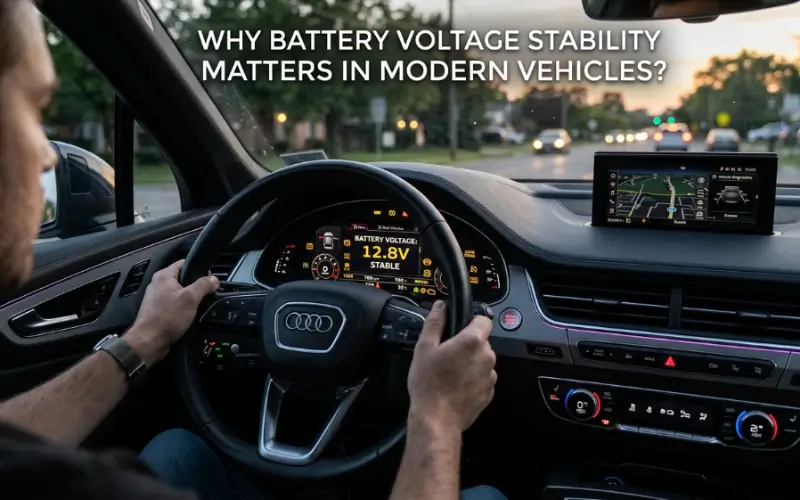
Modern vehicles are more than just cars with engines. They contain computers, sensors, and electronic systems that all require a dependable and reliable power source to function. A shaky power supply can make for some rapid problems.
The key to battery voltage stability is having a battery that provides a steady power supply at all times – no big jumps up or down and no decreases. As soon as the voltage becomes unstable, the electronic control systems in your car begin to malfunction, safety systems fail to function properly, and the engine control unit fogs up.
An unstable battery also puts additional strain on the alternator, reduces the life of the components connected to it, and can bring up warning lights that don’t seem to have a cause. For drivers who want a dependable solution built for the demands of today’s vehicles, a professional Varta battery change Dubai service ensures you get a battery that is properly matched to your car’s voltage requirements from day one.
What Is Battery Voltage Stability and Why Does It Matter?
The term battery voltage stability means that the battery is able to deliver a steady electrical power supply under various driving conditions, including idling, full load operation, and during engine-off periods.
When an automobile battery is fully charged and idling, it should have approximately 12.6 volts. The alternator increases it to 13.7 – 14.7 volts when the engine is on to keep everything charged and powered. When the battery fails to maintain its voltage level, the problem starts.
If it’s too low, electronic components won’t receive the power they require. Excessive voltage can cause harmful damage to sensitive circuits. There are dozens of electronic control units and sensors in modern vehicles that need high levels of steady voltage to work properly, and a small change can lead to a significant issue that may result in expensive issues throughout the vehicle.
How Modern Vehicles Depend on Stable Voltage?
Engine Control Unit Needs Consistent Power
In modern cars, the brain is known as the engine control unit or ECU. It tracks and tweaks a dozen or more functions simultaneously – such as fuel injection timing, air-to-fuel ratio, ignition timing, emissions control, and more. All these calculations are real-time and require a constant power supply.
The battery voltage is decreasing or fluctuating, and the ECU gets wrong signals or loses data during the process. This can result in issues with fuel economy, rough idling, unexpected stalling, or even a protective fail-safe mode limiting engine power.
Safety Systems Require Reliable Electrical Input
Many new vehicles are equipped with high-tech safety equipment like anti-lock brakes, electronic stability control, lane-departure warning systems, automatic emergency braking, and airbags. All these systems operate with electricity and need to be at a certain voltage in order to go into action at the proper time.
These systems can operate slowly, turn on too late, or not at all because of a battery that is not delivering consistent power. A safety system that fails to respond properly in an emergency due to voltage problems can have serious consequences.
Infotainment and Comfort Systems Are Affected Too
The voltage instability does not only cause problems for the mechanical systems. The infotainment screen, navigation system, climate control, power windows, seat adjusters, and parking cameras all depend on a consistent electrical power.
In cases where the battery voltage drops, these systems can freeze, reboot without warning, or act in unpredictable ways. So many people don’t take the time to find out that these are nothing but software glitches when, in fact, it could be an old battery that cannot maintain its power throughout the drive.
Start-Stop Technology Puts Extra Demand on the Battery
Many newer vehicles have start/stop technology, which means the car automatically turns off when it’s parked (such as at a red light), and restarts as soon as the driver lifts their foot from the brake. The feature has been designed to conserve fuel and emissions. But it also puts a far greater strain on the battery than a conventional system does.
Every time the engine starts, the battery has to produce a full, powerful charge – and it does this many times over on each trip. A battery that doesn’t maintain a steady voltage is simply unable to meet this requirement, resulting in slow system start-up, system failures, and accelerating battery degradation.
Signs That Your Battery’s Voltage Is No Longer Stable
Being able to identify voltage issues early will help you avoid more significant issues later. Watch out for these warning signs:
- Flickering headlights or dimming lights, particularly at low speeds or while idling.
- Slow engine crank when starting the car, even after the battery has been recently charged
- Random warning lights flashing on the dash without apparent reason
- Radio resetting itself, loss of settings and/or clock setting, computer resetting on its own, etc.
- Engine hesitation or stalling of engine within minutes of starting up
- This battery warning light remains on when the vehicle is running, indicating weak performance of the charging system.
- Self-disables start-stop system; the car’s computer frequently turns off this system if it senses that the battery is not powerful enough to sustain it.
What Causes Battery Voltage to Become Unstable?
A battery’s poor ability to maintain a constant voltage over time is caused by several factors.
Age and Natural Wear
All batteries will last for a certain period of time. Over the years, the inner lead plates deteriorate, and the electrolyte solution becomes weaker, which makes the battery weaker at maintaining the same voltage.
In warm climates, this deterioration is more rapid due to the increased rate of degradation of internal parts. If a battery is three years or older and is used in a hot climate, it could be exhibiting early signs of voltage instability although it is able to start the car every morning.
Sulfation from Repeated Deep Discharge
Repeatedly discharging the batteries to a very low state and then recharging them causes the lead sulfate crystals to form on the internal plates. This accumulation is known as sulfation, which raises the battery’s internal resistance.
The greater the internal resistance, the more effort the battery will need to make to provide the same output, resulting in irregular and unpredictable voltage output. If the battery begins to show signs of severe sulfation, it is very hard to remediate and will require battery replacement.
Loose or Corroded Battery Terminals
It’s not just the battery; it’s how that battery is connected to the rest of the car’s electrical system. Dirty or loose terminals develop resistance where they make contact.
This resistance will cause a drop in voltage between the battery and the systems in the car, which will create an unstable battery even if the battery is in good condition. Many people forget the importance of keeping the terminals clean and making sure that the clamps are tight.
Overloading the Electrical System
Aftermarket add-ons, additional lighting, high-power audio system, USB port charger, several USB chargers, etc., add to the overall electrical draw of the battery.
A standard battery won’t be able to keep the voltage level constant if it has not been designed to cope with this additional load. This is particularly so when the engine is shut off and accessories are connected to the battery.
The Right Battery Makes a Big Difference
Not every battery is constructed similarly, and the choice of the right type of battery for the specific needs of your car can have a significant impact on its voltage stability. Many modern cars, particularly with start-stop systems, regenerative braking, or many electronic systems, have a different type of battery, an AGM (Absorbent Glass Mat) battery, instead of a flooded battery.
AGM batteries are built to withstand more profound discharge cycles, have a quicker recovery rate, and provide more consistent voltage performance at high electrical loads. No matter how good the brand is, a standard battery will not perform as well in an AGM car as an AGM battery.
How Voltage Instability Affects Fuel Efficiency?
Many drivers don’t immediately realise this, but a poor battery can have a direct impact on fuel consumption. If the battery is not strong enough, then the alternator has to work harder and harder to compensate for it, adding a mechanical strain on the engine. From there, the engine consumes more fuel in order to drive the alternator at a faster speed.
In addition, an unstable charging voltage will cause the ECU to make wrong adjustments to the fuel injection system, which will result in a richer fuel mixture and poorer economy. Even something as simple as a battery that can’t maintain a steady voltage can slowly start to contribute to your fuel bill, and not even you will notice it.
Conclusion
Stability of the battery voltage is not just a minor technical point; it is the base on which all electronic and mechanical systems in a modern vehicle operate. With the engine control unit, safety features, fuel economy, or the infotainment system in the comfort of your car, all of which are running as they should be with stable voltage.
A failing, old, or mismatched battery can create issues throughout the vehicle that often go unnoticed until it truly fails to start the car. Regular battery testing, proper maintenance of terminals, and choosing the right battery type for your vehicle are the best ways to stay ahead of these issues and keep your car performing at its best for everyday driving in the UAE.
Must Visit: Sharjah Muroor Traffic Dept — Location, Timings