

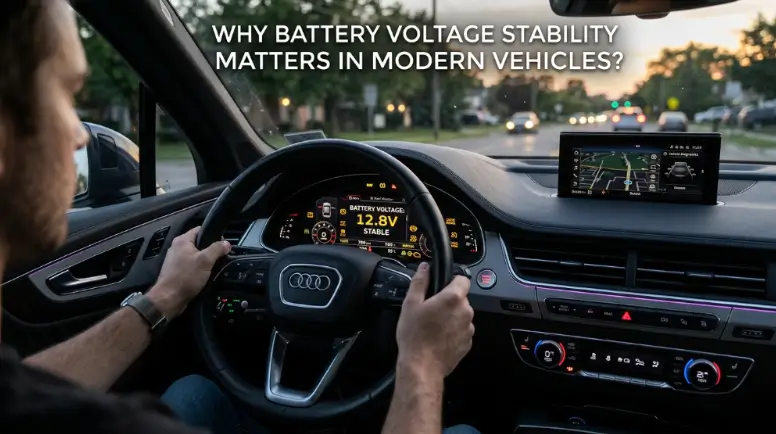
Nowadays, vehicles aren’t engines only. They contain a number of computers, sensors, a,nd electronic systems that all require a continuous and reliable power source to operate correctly. Even for the flickering of a昼, this power supply can go awry.
Stability of your battery’s voltage, that is, a level of power that remains steady throughout its life, rather than rising or falling or dropping suddenly. Once the voltage gets wobbly, the electronic machinery inside your car begins to go nuts, safety components begin not working properly, and engine control units go off check.
Not only that, the unstable battery puts additional strain on the Alternator; it will de-stress the connected components faster, and warning lights can come on for no apparent reason. For drivers who want a dependable solution built for the demands of today’s vehicles, a professional Varta battery change Dubai service ensures you get a battery that is properly matched to your car’s voltage requirements from day one.
What Is Battery Voltage Stability and Why Does It Matter?
Battery voltage stability is the battery’s ability to supply a steady supply of electric power under various driving conditions, which includes idling functions, running at top speed, and when the engine is stopped.
A healthy car battery will contain about 12.6 volts when it is totally charged and at rest. With the engine operating, the alternator increases this to 13.7 to 14.7 volts so as to maintain the voltages and charges needed. The trouble starts to happen as the battery can’t maintain the voltage.
If the voltage is too low, the electronic components will not be able to function. High voltage will cause damage to sensitive circuits. Many of the sensors and electronic control units that operate properly in today’s vehicles have a sensitivity that’s quite small and will produce real problems, if not costly ones, all over the vehicle if the supply voltage fluctuates.
How Modern Vehicles Depend on Stable Voltage?
Engine Control Unit Needs Consistent Power
The engine control unit (also known as the ECU) is the brains of modern cars. It controls andfine-tuness dozens of functions simultaneously, such as fuel injection timing, air-to-fuel ratio, ignition timing, emissions control, and more. All these calculations are done in real time and are dependent on the power supply.
If there is a drop in the voltage of the battery or a voltage fluctuation, wrong signals are sent into the ECU, or it loses information during a process. This can lead to lower fuel economy, shaky idling, sudden stalling, and the car entering a protective fail-safe mode which restricts the engine’s power.
Safety Systems Require Reliable Electrical Input
New cars are also equipped with state-of-the-art safety technologies including anti-lock brakes, electronic stability control, lane departure warning systems, automatic emergency braking,g and airbag protection. All of these systems can work on electricity, and need a steady voltage to switch on at the appropriate time.
Inconsistent power from a battery can result in delayed reaction, early reaction, or no reaction from the systems. A safety system which fails to respond correctly can cause dire consequences in an emergency situation due to voltage problems.
Infotainment and Comfort Systems Are Affected Too
Not only is there voltage instability in critical mechanical systems. The regular electric flow is necessary to fuel all of the infotainment screen, navigation, climate control, power windows, seat adjusters, and parking cameras.
These systems may freeze, restart prematurely,y or act abnormally when the battery voltage drops below normal. These may seem nothing more serious than a software problem for many drivers, but for one in particular, it is actually a malfunctioning battery that has a reduced output that results in these.
Start-Stop Technology Puts Extra Demand on the Battery
A newer technology, start-stop shuts the engine off when the car is at a red light, eg, and powers it up as soon as the driver lifts their foot off the brake. The benefit of this feature is fuel saving and reducing emissions. It uses the battery much more heavily, however, when compared to a traditional system.
Every time the engine starts, it has to produce a healthy kick with the battery in order to handle the start (sometimes dozens throughout a single trip). A battery that cannot meet this requirement will not deliver this power, resulting in delayed starts, system failures,, and battery deterioration.
Signs That Your Battery’s Voltage Is No Longer Stable
Spotting and resolving voltage issues early can make later issues a breeze to deal with. Beware of these signs:
- The headlights flicker or dim, particularly at the point of stopping or when idling.
- A slow start when the car starts (even if it has been charged lately)
- Random dashboard warning lights flashing for no apparent reason.
- The radio resetting on its own without user intervention, e.g., when reset its preset programs or even resets the clock.
- Rough start-up and/or hesitation at the start of running, detected from the engine side, usually a few moments after attempting a start.
- This battery warning light remains on during operation; this indicates a problem with the charging system.
- Deactivation of the start-stop system: If the computer recognizes that the battery does not have enough power to power the start-stop system, it will disable it.
What Causes Battery Voltage to Become Unstable?
There are some reasons why a battery over time will not maintain a constant voltage.
Age and Natural Wear
All batteries slowly lose their life! The internal lead plates become corroded, and the electrolyte fluid becomes weaker with the passage of time, and the battery will not hold a typical charge.
This process of ageing occurs more quickly in hot climates because the heat causes the internal components to break down more quickly. Even if the battery starts the car every morning, after 3 years or more in a hot environment it may already be exhibiting moderate voltage instability.
Sulfation from Repeated Deep Discharge
Lead sulfate crystals can form inside the plates of a battery when it is constantly discharged and recharged to a very low voltage.
Higher internal resistance means the battery has to work harder to deliver the same output, which leads to uneven and unstable voltage delivery. Once sulfation becomes severe, it is very difficult to reverse, and the battery needs to be replaced.
Loose or Corroded Battery Terminals
But as significant as the battery is, the relationship of the battery to the rest of the car’s electrical system. Resistance at the point of contact comes from the loose or corroded terminals.
This resistance contributes to a voltage loss in the system from the battery to the vehicle’s systems, even if the battery condition is not in a state of instability. It’s an easy maintenance task that a lot of drivers do not perform: Clean and tighten terminals regularly.
Overloading the Electrical System
Installing extra lights, audio, lounge furniture, an aftermarket electronic system, and/or adding additional USB ports or chargers to the car loads the battery with added power usage.
Unless the battery’s design specifications are intended for that additional load, it will be unable to sustain consistent voltage and voltage drop when connected to the additional load. Particularly if the engine is not running, and accessories are still consuming the battery’s power.
The Right Battery Makes a Big Difference
There are different types of batteries,s and the right battery for the car’s particular needs is an important factor in stabilizing voltage. AGM (Absorbent Glass Mat) batteries are used instead of flooded batteries in modern vehicles, particularly those that have electronically controlled systems or start-stop systems or lots of electronic systems.
AGM batteries are designed to be able to undergo deeper discharge cycles, recover more quickly, and maintain a more level voltage output load. For example, if the car uses an AGM battery, then that’s what is needed, and simply fitting a standard battery will not result in any good performance with respect to battery life or performance of the car, regardless of the brand.
How Voltage Instability Affects Fuel Efficiency?
Many drivers aren’t immediately aware of this, but when your battery is having trouble, it also reduces the amount of fuel your vehicle consumes. If the battery is weak, the alternator must run harder to make it up, and it increases the mechanical strain on the engine. The alternator, forced to spin harder, then uses additional fuel that is required for keeping the engine running.
In addition, the ECU receiving uneven voltage may make miscalculations and perform fine-tuning of the fuel injection system improperly, which will result in a more fuel-rich mixture and reduction in economy. A minorl battery, for instance, one that can’t maintain a steady voltage, can subtly be the cause of extra expenses week by week.
Conclusion
Stability testing of the battery voltage is no minor technical detail; it’s the groundwork upon which all electronic and mechanical systems in a contemporary vehicle are constructed. Stable voltage is what power operations need, from vehicle electrics and electronics to its safety features, from gas mileage to the comfort of your infotainment system.
Battery issues can silently affect a vehicle’s entire system before they even lead to failure. As the battery itself ages, wears, or is matched, ed it can cause a myriad of issues. The most effective ways to prevent these problems and get your car up and running for your day-to-day driving experience in the UAE are to perform routine tests on the batteries, keep the terminals clean, and ensure the correct battery type is used for your vehicle.
Must Visit: Sharjah Muroor Traffic Dept — Location, Timings and Step-by-Step Guide for Drivers and Car Owners