
It’s a Sunday morning at a warehouse in Al Quoz. Eleven pallets of kitchen appliances are wrapped, labelled and waiting for a retailer in Riyadh. The operations manager has two quotes open on her laptop. One is for a full truck. The other is for a shared spot on a groupage truck leaving later in the week.
The shared option is cheaper on paper, so she’s about to click “confirm.”
Most shippers stop at that point, and it’s often where money gets lost. On the Dubai–Saudi lane, the true cost per pallet depends on much more than the number on the quote. It depends on how many pallets you’re moving, what they weigh, how fast they need to arrive, and one border crossing that every truck on this route has to pass through.
Forwarders such as Fast Ship in Dubai quote both options on this corridor every week, and the question shippers ask most is a simple one: which is actually cheaper? Here’s how to work it out.
What FTL and LTL Really Mean on This Route
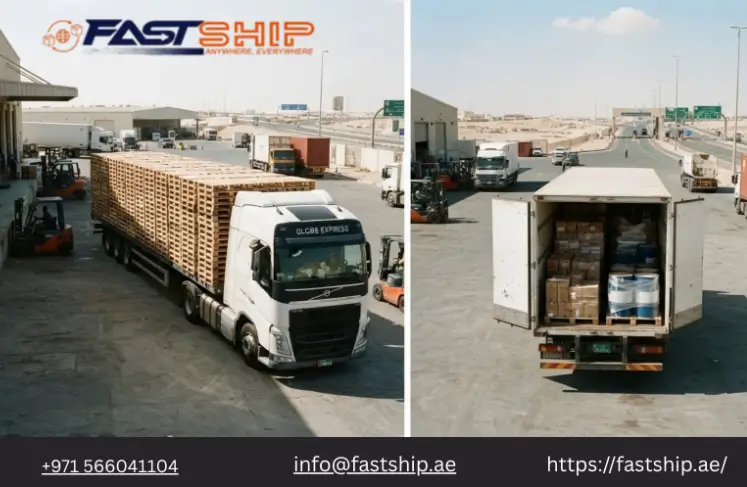
FTL (Full Truckload) means you book the entire trailer. The truck loads at your door, gets sealed, and drives straight to your consignee. Nobody else’s cargo is on board.
LTL (Less Than Truckload), often called groupage in the Gulf, means your pallets share a trailer with other shippers’ goods. The freight is consolidated at a warehouse in the UAE, trucked across the border, and then split up at a hub in Saudi Arabia for final delivery.
Before comparing costs, you need to know how much fits in a truck. A standard 13.6 m curtain-side trailer holds 33 Euro pallets (120×80 cm) or 26 standard pallets (120×100 cm) in a single layer. Space isn’t the only limit, though. For heavy freight and break bulk cargo, the weight limit is usually reached long before the trailer is full.
That point matters later, because a truck full of floor tiles and a truck full of pillows are priced very differently per pallet.
The One Border Every Pallet Has to Cross
If you’re planning regular shipping from Dubai to Saudi Arabia, one crossing shapes almost every cost decision you make. Al Ghuwaifat on the UAE side and Al Batha on the Saudi side form the only land crossing between the two countries, so FTL and LTL trucks alike pass through the same gate.
Paperwork makes a big difference here. With complete and consistent documents, cargo commonly clears in two to four hours. Incomplete or inconsistent paperwork, or cargo flagged for inspection, can stretch that to a day or more. In 2026 the crossing has been under extra strain, with some firms reporting waits of several days and drivers occasionally stuck for over a week.
On the Saudi side, the requirements are strict. Clearance needs a SABER Shipment Certificate of Conformity and a customs declaration filed through Saudi Customs’ FASAH platform, alongside the commercial invoice, packing list and certificate of origin.
This is where the FTL vs LTL choice gets more serious than most quotes suggest.
With FTL, the only paperwork on that truck is yours. If your documents are clean, your truck moves.
With LTL, your pallets travel with other companies’ documents. If one shipper on the trailer has a mismatched HS code or a missing SABER certificate, the whole truck can be held while it’s sorted out. Your paperwork can be perfect and your cargo can still end up waiting.
The Per-Pallet Math: Finding Your Break-Even Point
You can compare the two options with one simple calculation:
Break-even pallets = FTL price ÷ LTL price per pallet
Say your full-truck quote is 14 times the per-pallet LTL rate. Your break-even is 14 pallets. Below 14, LTL is cheaper on paper. Above 14, a full truck costs less per pallet, and you get the whole trailer to yourself.
Back in Al Quoz, the manager’s 11 pallets sit just under that line. So LTL looks like the winner. To be sure, she needs to add the costs the quote doesn’t show.
The Hidden Costs of LTL
- Extra handling. Groupage pallets are loaded, unloaded at a consolidation hub, reloaded, and then unloaded again at a Saudi distribution point. Every touch adds some risk of damage, which matters a lot for appliances, glassware or electronics.
- Waiting for the truck to fill. Shared trucks usually leave when they’re full or on a set schedule. Your pallets may sit for a few days before departure.
- Shared border risk. One bad document from another shipper can hold up your delivery.
- Chargeable weight. LTL rates are often calculated on actual weight or volume, whichever is greater. Dense cargo can cost more than the headline per-pallet rate suggests.
The Hidden Costs of FTL
- Paying for empty space. If you book a 26-pallet trailer for 9 pallets, you’re paying for 17 empty spots.
- Minimum commitment. It’s the same price whether the trailer is full or half-empty.
For stackable goods, there’s a simple way to improve the FTL numbers. Double-stacking can double the pallet count, which cuts your cost per pallet sharply, as long as the load stays within the weight limit.
When LTL Is the Smarter Choice
LTL usually makes sense when:
- You’re shipping well below your break-even pallet count, typically a handful of pallets.
- Your delivery date has a few days of flexibility.
- The goods are sturdy, well-packed and not especially high in value.
- You send regular, small top-ups of stock to Riyadh or Dammam rather than one-off bulk loads.
- You’re an e-commerce seller restocking a Saudi warehouse on a steady cycle.
For small, frequent shipments, groupage within a well-run road freight network keeps working capital free and avoids paying to move empty trailer space across the peninsula. What matters is how often trucks actually depart and whether every consignment’s paperwork is checked before the truck reaches the border.
When FTL Pays for Itself
FTL is usually worth it when:
- You’re at or above your break-even count, or close enough that the hidden LTL costs tip the balance.
- The cargo is fragile, high-value or time-sensitive.
- There’s a single consignee, so the truck can go straight from your door to theirs.
- The goods are dense or heavy, so the trailer reaches its weight limit with only a few pallets loaded.
- The destination is far from the border.
Distance matters more than people expect. A clean, pre-cleared truck from Dubai to Riyadh realistically takes 24 to 36 hours from loading to delivery. Dubai to Jeddah is more than 1,200 km and typically takes 48 to 72 hours door-to-door when everything goes right. On a trip that long, the extra hub stops and transfers in an LTL network add even more time and handling.
Five Questions to Ask Before You Book
Before you confirm either option, ask your forwarder:
- What is my exact break-even pallet count on this lane? Get both quotes on the same day so you’re comparing like for like.
- Is the LTL rate charged per pallet, per CBM or by weight? The answer can change your total a lot.
- When does the next groupage truck actually leave? “Weekly” and “daily” departures mean very different delivery dates.
- Who checks the paperwork of other shippers on my truck? A good forwarder checks every consignment before the truck leaves the UAE.
- Can my goods be double-stacked? If so, FTL could cost much less per pallet than you think.
A forwarder that offers both options can run these numbers with you, instead of steering you toward whichever one suits their schedule.
Back in Al Quoz
So what should our operations manager do with her 11 pallets?
She ran the break-even calculation. Then she added the hidden costs: appliances are fragile, the retailer wants delivery before a promotion starts, and the shipment has only one consignee. Those three factors pushed her toward booking the full truck.
She paid for a few empty pallet spaces. In return she got a sealed trailer, no transfers between hubs, no dependence on anyone else’s paperwork, and delivery she could plan around.
On a different week, with five pallets of packaged goods and no deadline, LTL would have been the clear choice.
Neither FTL nor LTL is always cheaper. The cheaper option is the one that matches your pallet count, your cargo and your deadline, and you can work that out with a calculation and a few questions before you book.