
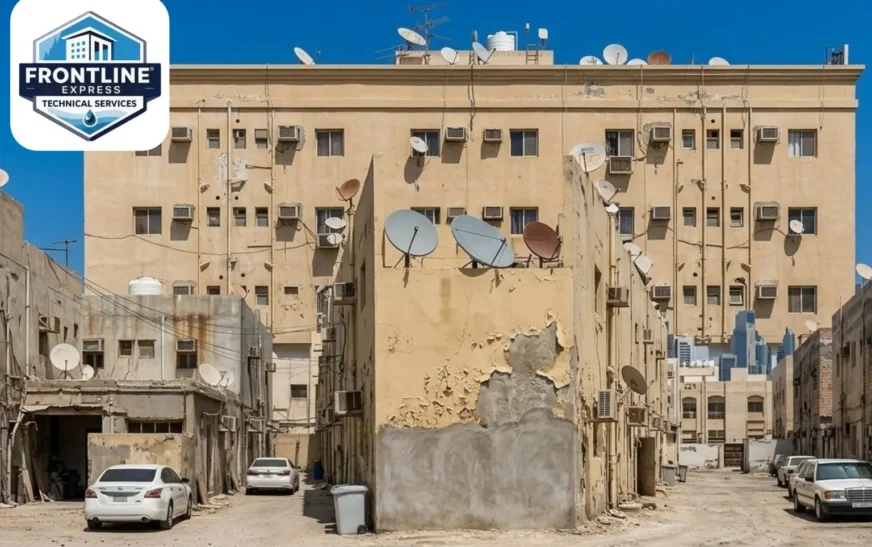
A villa owner in Mirdif showed us photos of his exterior taken the week his painters finished. Crisp, even, a clean off-white. Then he showed us his phone camera from that morning, fourteen months later: chalky white powder coming off on his hand, hairline cracks tracking across the west wall, and paint lifting in sheets above the garage where the afternoon sun hits hardest.
He hadn’t been cheated on price. He’d been given exactly what he paid for: a thin film of low-grade paint applied quickly over a wall that was never properly prepared. In Dubai, that combination has a predictable lifespan, and it’s shorter than most owners expect.
At Frontline Technical Services, we’ve seen how quickly these failures appear when either the material or the preparation is compromised. This is a look at why it happens, split into the two things that actually decide how long a paint job lasts: the material and the application.
Quick answer: Cheap paint jobs fail in Dubai within 18 months because low-grade paints use weak binders and organic pigments that break down under extreme UV, and because rushed application skips surface cleaning, primer and correct film thickness. Heat, salt air and daily thermal movement then do the rest. The paint isn’t the only problem; the preparation usually matters more.
Part 1: The Material
What you’re actually buying
Exterior paint is a binder, pigment, extenders and liquid. Cut the price and something has to give, usually in this order:
| Component | In quality exterior paint | In cheap paint |
| Binder (resin) | 100% acrylic or elastomeric, flexible and UV-stable | Vinyl or low-grade blends that harden and crack |
| Pigment | Inorganic pigments and high titanium dioxide content | Organic pigments that fade, plus less TiO₂ |
| Extenders/fillers | Balanced for durability | Heavy filler loading to cut cost |
| Solids content | Higher, so each coat builds real film thickness | Lower, so coats look thin and need more of them |
| Elongation | Can stretch as the wall expands and contracts | Little flexibility, so it splits at hairline cracks |
What the UAE climate does to paint, measured
Researchers at the American University of Ras Al Khaimah exposed three different high-SRI white paints to natural weathering in the UAE for three years. These were reflective, high-specification coatings, not budget products.
After three years:
- Reflectance values dropped significantly compared with unexposed samples.
- Solar Reflectance Index fell from between 95 and 110 down to between 60 and 90.
- Colour difference increased measurably.
The exposure site recorded an average global solar radiation of 638.3 W/m².
The point isn’t that good paint fails. It’s that UAE conditions measurably degrade even high-performance coatings over three years. A budget paint with a weaker binder and organic pigments is working against the same forces with far less to resist them, which is why its visible life is measured in months rather than years.
The four forces at work
- UV photodegradation. Ultraviolet light breaks the polymer chains in the binder. The surface loses its seal and releases loose pigment as powder, which is what “chalking” means when you get white residue on your hand.
- Thermal cycling. A sun-facing wall can swing dramatically between its midday and pre-dawn temperature. The substrate expands and contracts daily, and a rigid film cracks rather than moving with it.
- Salt and humidity. In coastal areas, airborne chlorides and overnight humidity drive moisture into the surface, pushing paint off from behind as blisters.
- Sand abrasion. Shamal winds scour exposed elevations, thinning the film mechanically.
Part 2: The Application
In our experience, more failures come from this half than from the paint itself. A good product applied badly still fails; a mid-range product applied correctly often outlasts it.
Where cheap jobs cut corners
- No proper surface cleaning. Paint will not bond to dust, sand, salt or chalk from the previous coat. On multi-storey buildings this is the step most often skipped, because it needs access equipment. A proper facade cleaning before painting isn’t an optional extra; it’s what gives the new coat something to grip.
- No primer. Primer seals porous render, blocks stains and creates adhesion. Skipping it saves a day and costs years.
- Cracks painted over, not repaired. Paint spans a hairline crack for one summer at most. The crack moves; the film splits along it.
- Film thickness too low. This is the invisible shortcut. Over-thinning the paint or stretching coverage beyond the manufacturer’s rate leaves a film thinner than specified. It looks identical on day one and behaves nothing like it in year one.
- Painting in the wrong conditions. Applying to a hot, sun-facing wall makes the paint skin over before it can bond. Summer work needs early mornings, shaded elevations and respect for the maximum surface temperature on the product data sheet. October to April is the sensible window.
- Painting over failing paint. New coats over chalking or lifting paint fail wherever the old layer lets go. The old coating has to come off first.
- No community colour approval. Not a durability issue, but an expensive one: many Dubai communities require colour approval or an NOC before exterior work, and painting outside the palette can mean repainting at your own cost.
The 18-Month Failure Timeline
Here’s how a cheap exterior job typically progresses on a Dubai villa or building:
| Period | What you see | What’s happening |
| Months 0–3 | Still looks good; slight gloss loss | Surface binder starting to degrade under UV |
| Months 3–6 | Colour looks slightly washed; faint powder on touch | Chalking begins; pigment releasing |
| Months 6–12 | Visible fading on south and west walls; patchy appearance | Organic pigments breaking down; film thinning |
| Months 12–18 | Hairline cracking, edge lifting, blistering near ground and parapets | Adhesion failure and moisture ingress behind the film |
| Beyond 18 months | Peeling sheets, exposed render, staining | Substrate now unprotected; repairs needed before repainting |
West- and south-facing elevations always fail first. If one wall of a building looks years older than the others, that’s why.
The Cost Maths Owners Miss
Compare two approaches over the same six years.
The cheap cycle: paint at year zero, visible failure by 18 months, repaint at year two, again at year four, again at year six. Three full jobs, and by the third one you’re also paying for render repairs where moisture got behind the film.
The proper cycle: correct preparation, primer and a UV-stable system applied at specified thickness. One job, with touch-ups. Repainting becomes a planned maintenance item rather than an emergency.
The difference isn’t the price of a bucket of paint. It’s the number of times you pay for access equipment, labour and preparation, which is where most of the cost of any exterior job actually sits.
How long your own cycle should be depends on exposure and substrate; our guide to how often to repaint a villa or building in the UAE sets out realistic intervals.
Coastal Buildings Need an Extra Step
Properties near the water carry a load that inland buildings don’t. Airborne chlorides settle on walls and stay there, and painting over them traps salt under the film, where it draws moisture and lifts the coating from behind.
That applies along the Dubai coast and just as much in Sharjah, where towers and villas in Al Khan, Al Mamzar and along the corniche sit in constant sea air. Before repainting any of them, the salt has to come off: a thorough facade cleaning in Sharjah removes the chloride deposits that would otherwise be sealed in. Owners booking painting services in Sharjah should ask for salt removal by name, because it’s the step most quotes leave out.
What a Proper Specification Looks Like
When you request a quote for exterior work on a home, ask for these seven items in writing:
- Surface preparation: washing, salt removal on coastal properties, removal of loose and chalking paint.
- Repairs: crack filling and sealant replacement before painting starts.
- Primer: named product, appropriate to the substrate.
- Coating system: UV-resistant acrylic or elastomeric, with the product data sheet attached.
- Number of coats and film thickness: stated, not implied.
- Timing: the working window, and how hot surfaces will be handled.
- Warranty: what’s covered and for how long.
A contractor who can answer all seven is quoting a different job from one who quotes a price per square metre and nothing else. That’s usually the whole difference between the two quotes.
The list is the same whether you’re arranging villa painting on a single home or building painting across a tower, though on multi-storey work you should also confirm the access method and how the team will handle upper floors safely.
Conclusion
Cheap paint jobs in Dubai don’t fail because of bad luck. They fail because a low-grade film with weak UV resistance is applied over an unprepared surface in a climate that attacks coatings from four directions at once.
Research in the UAE shows even high-performance reflective paints lose a measurable share of their performance within three years. Budget paint, applied quickly, simply gets there faster. Spending on preparation and a proper coating system is what turns repainting from a recurring emergency into a scheduled job.
FAQs
- How long should an exterior paint job last in Dubai?
With proper preparation and a quality UV-resistant system, several years before a refresh is needed. Cheap systems often show visible failure within 12 to 18 months.
- What is chalking, and is it a sign of bad paint?
Chalking is loose pigment released as the binder breaks down under UV. All paints chalk eventually; cheap paints chalk far sooner.
- Why does only one side of my building look faded?
South- and west-facing walls take the most solar exposure and the largest daily temperature swing, so they always degrade first.
- Can I just paint over peeling paint?
No. New paint bonds to whatever is under it. If that layer is lifting, the new coat lifts with it. Loose material has to be removed first.
- What’s the best time of year to paint exteriors in the UAE?
October to April. Summer surface temperatures often exceed the maximum application temperature on the product data sheet.
- Does expensive paint guarantee a long-lasting result?
No. Preparation, primer and correct film thickness matter as much as the product. Good paint applied badly still fails early.